NARCOTICS GROUP
HISTORY
|
|
NARCOTICS GROUP HISTORY |
|
|
|
|
|
|
|
|
|
|
|
|
r
|
|
||
| o | ||
On January 2, 1991, the then PC/INP was deactivated and a new National
Police was created pursuant to Republic Act 6975, known as the PNP Law.
The AFP NARCOM's function was absorbed by the new PNP Narcotics Command
which revitalized the integration of all drug law enforcement efforts
in order to realize the objective of destroying the drug trafficking network
and to prevent and control demand and drug abuse under the leadership of
BGEN JOB A MAYO JR. The year 1991 ushered in the need for NARCOM to go
on networking to enhance total collective campaign to fight drug abuse.
This time under the Directorship of then POLICE SENIORSUPERINTENDENT RAMSEY L OCAMPO, in 1993, NARCOM estimates disclosed that the extent of the drurg menace exaberated the national crime rate 50%, with about 60% of showed the drug problem concentrated in Metro MAnila. Equally disturbing was the fact that the Philippines has become a major transshipment point for international drug traficking. Moreover, the country has become one of the major exporters of marijuana. OPLAN GREENGOLD was thus operationalized to extensively pursue MJ-eradication all over the archipelago. Its relentless and intensified oeprations against drug syndicates and drug dealers/pushers achieved modest gains in NARCOM's anti-drug efforts in 1993 through its OPLAN THUNDERBOLT (vs Drug Syndicates/Lords) and against secondary street-level drug pushers under OPLAN ICEBERG. |
||
| oO | ||
|
|
||
| O | ||
The
drug menace persisted despite the effectiveness of the national strategy.
Thus, the year 1995 saw the need to reinvent dryg law enforcement.
There was a felt need for new drug enforcement tools and new drug enforcement
methods and techniques. Accomplishment-wise, NARCOM made series of
successes in drug law enforcement that started in the seizure/confiscation
of 91 kilos of shabu worth P182,000,000.00 in La Union and the neutralization
of an international drug syndicate member (Stanley Tan).
In the pursuit of its drug demand-reduction strategy, the Command doubly intensified its Drug Abuse Preventive Education with some 139,314 students/youths, parents/barangay residents, NGOs/POs member benefiting from it. The Command likewise, maximized its public information awareness efforts through the tri-media and pursued other anti-drug campaigns and Police Community Relations activities, to include its treatment-and-rehabilitation programs (Sagip-Yagit) and (Sagip-Kabataan). |
||
| O | ||
|
|
||
| O | ||
Recognizing
that drug Drugs Ends All Dreams (DEAD), NARCOM has forged a vision:
Working together towards a drug-free Philippines. True to his (PIAD)
words, in early 1996, the PNP NARCOM made the biggest haul ever in
the field of drug law enforcement: seizure/recovery of some 140 kilos of
shabu with a market value of P280 million and the neutralization of a drug
syndicate member (Chen Tin Lun), busting the pipeline of shabu in the China-HK-Philippine
Connection. This was followed by the seizure/confiscation of 1.5
kilos of heroin and the arrest of another drug syndicate member (Chen Chi
Chung). NARCOM had confiscated/recovered P1.89 Billion worth of illicit
drugs and arrested 999 persons including 25 foreigners, 22 members of the
PNP/AFP, and 8 killed in action.
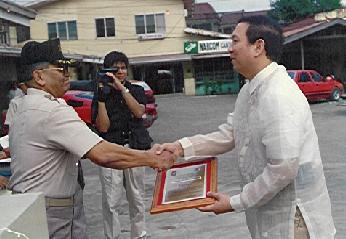
On 27 May 1996, in Resolution Nr. 40 of the 10th Congress, NARCOM earned the highest recognition from the House of Representatives (Congress) for its outstanding and meritorious accomplishments in the field of drug law enforcement-NARCOM seized approximately P3.7 Billion worth of drugs and arrested 2,874 persons including 40 foreigners in two (2) years under then P/CSUPT PIAD. During the DDB recognition rites in celebration of Drug Abuse Prevention and Control (DAPC) week 14 November 1996, P/CSUPT PIAD was given a Plaque of Recognition by the DDB for his and his unit's efforts in the anti-drug campaign. Then, on 18 November, he (PIAD) received from the International NArcotics Enforcement Officers Association (INEOA) based in the United States of America, the International Award of Honor hall of fame, for his and his unit's invaluable contribution to and exemplary performance in the campaign against illicit drugs. Despite commendable efforts at drug law enforcement, the ranks of drug abusers continued to grow, thus, drug demand reduction efforts were now equally matched with drug supply reduction efforts. Necessarily, the cooperative partnership of police community-LGU and the collaborative relationship between and among the 5 pillars of the Criminal Justice System were deemed imperative to defeat the growing drug menace. A people's initiative against drugs and the organization-and-mobilization of anti-drug coaliton/groups had to be orchestrated by the group. |
||
| oO | ||
|
|
||
| oO | ||
The
year opened with Gen. PIAD being awarded as the "HERO OF THE WEEK" by DZEC
radio program, "best friends kontra droga". Focusing attention to target
drug abusers and batting for a policy of drug-test as part of health care
program in the PNP/AFP, GOs/NGOs/POs including the provision for mandatory
rehabilitation and confinement of drug dependents, Operation BANAT (Barangay
Against Narcotics Abuse and Trafficking) has been conceptualized on July
1997 by NARCOM. Basically a barangay-cleansing project, its components
are: the identification of drug-affected barangays; neutralization
of drug pushers and abusers: intensified conduct of DAPE/CI and PCR/PIA
programs including PI & E/PEVO and MRP activities (to enhance public
awareness of the drug menace and drum up community support and citizen
involvement in drug law-enforcement, Preventive Education and Community
Information); treatment and rehabilitation efforts-insuring that
the barangay is drug-free and empowered to sustain a drug-free barangay,
a co-called "BARBERRS" barangay: A Barangay that is Awakened and
Reformed Brought about by an Enlightened and Responsive Society. Thus,
the five (5) Metro Narcotics District Offices conducted BANAT operations
in piloted Metro-Manila barangays accounting for some 1000-persons; identified
pushers were accordingly charged for violations of RA 6425 and those found
positive for drug use were brought to rehab centers.
P/SSUPT REYNALDO M ACOP emphatically announced that NARGRP under then P/CSUPT PIAD left a legacy in the government's anti-drugs campaign as "it's (NARGRP) efforts and contribution to the national strategy (of Drug-Supply and Drug-Demand Reduction) towards a drug-free Philippines raised the level of consciousness and enhaced public awareness about the drugs and the evils and consequences it bring about reaching far and wide across and within the nation and civil society". In short, P/CSUPT PIAD's expose about the menace stirred a "hornet's nest", so to speak. On his (ACOP) shoulders now rested the initiative to pursue Operation BANAT, P/SSUPT ACOP embarked on a revamp-and-clean up of organization and renamed NARGRP as PNP ANTI-NARCOTICS GROUP, with the Regional Narcotics Offices as Regional Anti-Narcotics Offices (RANOs) and Metro Manila Narcotics District Offices (ANDOs). On 8 December 1997, in accordance with the PNP staffing pattern and in order to come up with a lean-and-mean organization to enhance operational effectiveness in narcotics operations in MMA, these ANDOs were reorganized into two (2): South Metro Narcotics District Office (SMNDO) which has jurisdiction over Manila, Makati City, Pasay City, Marikina city, Muntinlupa city, Las Pinas, Paranaque, Taguig, Pateros and San Juan and North Metro Narcotics District Office (NMNDO) covering the areas of Quezon city, Caloocan City, Malabon, Navotas and Valenzuela. Just two (2) days after the change of command of the PNP leadership (from DIR GEN RECAREDO A SARMIENTO II to DIR SANTIAGO L ALINO), P/SSUPT ACOP received his promotion to P/CHIEF SUPERINTENDENT effective 19 December 1997. |
||
| o | ||
|
|
||
| o | ||
| On
the occasion of the Group's 26th Founding Anniversary where 26 police officers
were awarded medals of recognition for their respective role-and-contribution
in the anti-drug campaign, P/CSUPT ACOP asked his men, PNP personnel and
their dependents to "Be drug-free and stay-drug-free". The statement
is actually an acronym of his Drug Abuse Prevention and Control (DAPC)
tips.
The year saw NARGRP make a major breakthrough in reforming its not-so-positive image. Acop was cited by the UNited States government for his Internal Reforms Program that resulted to the relief of members found to be drug users themselves or either directly or indirectly involved in the illicit drugs trade. The US Drug Enforcement Agency (DEA) further cited Acop for transforming NARGRP into a "more credible anti-narcotics unit" as well as making significant dents in joint US-Philippine efforts against drugs. Under P/CSUPT ACOP's stewardship, approx P390 million worth of drugs including a big quantity of heroin were seized/confiscated. 24 foreigners were among some 1,496 persons arrested for big-time drug trafficking, including a level-2 drug personality, Dewey Dy y Yap. A year after its implementation, Opertion BANAT proved its effectiveness-collaborative barangay participation and support let to the sucess of a joint PNP Police Regional Office 2 (PRO2) - NARGRP's recovery/confiscation of some 235 kilos of liquid and crystalline shabu from a northern island-municipality in the Cagayan region on June 1998. Estimated to be worth P465 million, this is the biggest haul of shabu for the year. As a result of subsequent narcotics operation, five (5) persons including a member of the 14K drug syndicate were likewise arrested and charged according for violation of RA 6425, as amended by RA 7659. When P/SSUPT REYNOR R GONZALES - a CANU "original" - took over the leadership of NARGRP on 24 August 1998, he beefed up the personnel strength of SOD and the RNOs and merged the two (2) Metro NDOs into one (1) Metro Manila Narcotics Office (MMNO) in compliance with the AC, PNP's DREAMS Strategy of community policing - the dispersal of 85% of the group's total strength to the field. Pursuing the humble operational accomplishments of his predecessors and orchestrating allied narcotics operations at Police Regional/District/Station-levels, MMNO operatives, combined elements of SOD, PPO's, RNOs - in coordination with the Presidential Anti-Organized Crime Tasked Force (PAOCTF) under P/DIR PANFILO LACSON - conducted narc operations notable of which is the series of operations launched against Filipinos and Nigerians where some P50 million worth of heroin and cocaine were seized/confiscated by joint Philpost-Bureau of Customs-PASCOM-NAIA Police-NARGRP teams. Overall, these oerations, netted some P132 million worth of drugs including cocaine concealed in perfume containers, diaries and heroin well-concealed in blades of butchers knives. Among the 560 persons arrested, 11 were foreigners including two (2) 14K gang members. P/SSUPT GONZALES has likewise sustained vigorous bu focused implementation of Operation-BANAT in close collaboration with local PNP police offices nationwide by deploying operating teams in the barangays, especially in drug prone/source areas, with the assistance of Barangay Leaders and Tanods and with the involvement of the Multi-Sectoral Community which maximized citizen participation. Thus, with Pasig City at the pilot project area, in a three(3) month period some 252 drug pushers and users were rounded up for drug possession/pushing and/or during pot-session. Before the year ended, NARGRP - in cooperation with DSWD's Ahon-Bata sa Lansangan program - conducted Oplan Sagip-Yagit and rounded up a hundred street children, so-called "Rugby Boys", to keep them off the streets, away from drugs and crimes. |
||
| o | ||
|
|
||
| o | ||
| Despite
earlier efforts of government and NARGRP to stem the tide of drugs proliferation
and reduce/control drug abuse, the drug menace loomed as a serious national
security threat - the population of drug users ranks continued to grow
with 1.2 million aged 15-30 years old as drug users; ; 70% of crimes committed
were drug-related, the no. of MJ plantations grew to 98 sites located in
9 regions; 70% of drug activities were concentrated in MMA; drug-affectation
of some 6,000 plus barangays; and the country remained a significant spot
in the global drug map, either as importer/exporter/cultivator/consumer
of and/or transit point for illicit drugs.
Disturbed by the seriousness of the drug problem, no less than His Excellency, President Joseph E Estrada, has called for a massive anti-drugs campaign in his desire to attain A Drug-Free Philippin by the year 2000. Thus, under the auspices of the PAOCTF and spearheaded by NARGRP, a series of planning conferences/workshops came up with a list of barangays with drug-affectation, identification of Drug Supply Hierarchy (DSH), and a list of drug pushers and users to be targeted for the campaign. For five (5) days, starting 15 January, in one sweep by the PNP, NARGRP and the PAOCTF, some 1733 persons were arrested, identified to be drug traffickers, pushers and users, approximately P72 million worth of shabu, marijuana and other illicit drugs were seized/confiscated/ On 15 January 1999, Exec Order Nr 61 was signed by PJEE creating the National Drug Law Enforcement and Prevention Coordinating Center (NDLEPCC), a single body especially tasked to orchestrate and consolidate the drug law enforcement and prevention efforts to national government agencies, LGUs and NGOs to have a more effective anti-drugs campaign at the national down to barangay levels. Chairmanned, by PJEE as concurrent SILG, the NDLEPCC has the CPNP as Vice-Chairman with the Chief, PAOCTF; Chairman, DDB; Director, NBI; Commissioner, Bureau of Immigration; Chief, National Prosecution Service and Commissioner, Bureau of Customs as members. PJEE appointed P/DIR JEWEL F CANSON as the Executive Director of its secretariat, with participating agencies that include the DOH, DOJ, DND, DECS, DOF, DSWD, DOLE, DDB, PIA, PNP, AFP, NBI, National Prosecution Service, Bureau of Customs, BIR, BID, NICA, EIIB, PCG, Philpost and other agencies, as needed. ACTIVITIES OF THE UNIT Strategy: Supply Reduction - is addressed in various OPLAN's: against high level drug trafficking organizations and an expanded street level operations that tend to disrupt and disorganized drug pushing activities. Demand Reduction - is dedicated to deny the market from drug syndicates, pushers, and consisting of preventive information and education, and treatment and rehabilitation. International Cooperation - involves continuing liaison with international drug enforcement agencies on mutually supporting reporting relationship against international drug trafficking. This encompasses foreign training exchange, in service training, intelligence exchange, marijuana eradication and infusion of modern equipment and facilities. Intra-unit Coordination Exchange is to effect a well-organized nationwide drug law enforcement thrust. This includes training exchanges and operational coordination. Legal Offensive - ensures successful prosecution of drug-related offense cases that bring focus the conduct of evidence-oriented investigation, case tracking, prosecutory, development and research. National Dimension:
Neutralize high-level drug traficking organization.
International:
Effective network and intelligence exchange.
|
 .
.